Thursday, December 9, 2010
London and Bath: Thanksgiving in England
After a bus ride from the airport of London's city center, I set off to explore and immerse myself in one of the world's most important cities. Even from the bus, I was fascinated by London's complex and diverse urban structure as long rows of town homes on the periphery gave way to office towers, train stations, and other urban building types in the city center. I ventured past many different buildings and structures I had learned about over the years. Some of the places I went to included the church of St. Martin-in-the-Fields, the Millennium Bridge, the Bank of England, and St. Paul's Cathedral. No matter where I go, I always get a kick out of seeing buildings that I used to see in all my textbooks freshman and sophomore year.
Like Rome, London is a maze of turning streets, large thoroughfares, small alleys, and humble lanes. It was an experience in itself trying to navigate the cities organic street layout. Over the course of the day this led to many wrong turns, but also led me to go places and see buildings I might not have ran into had I taken another route. The architecture of the city was also very mixed. There were many buildings built in a traditional manner, whether Gothic, Romanesque, or Classical, that stood right next door to a new modern office building. The combination of different architectural styles created a very interesting blend of old and new that had something new in store around every corner.
I spent Thanksgiving and the following Friday exploring all London had to offer, seeing the aforementioned buildings along with many other well-known and some not as well-known structures. I went and saw the Houses of Parliment, Big Ben, Westminster Abbey, and Buckingham Palace like everyone else who visits London, but I also went and saw a couple other buildings that don't get as much attention.
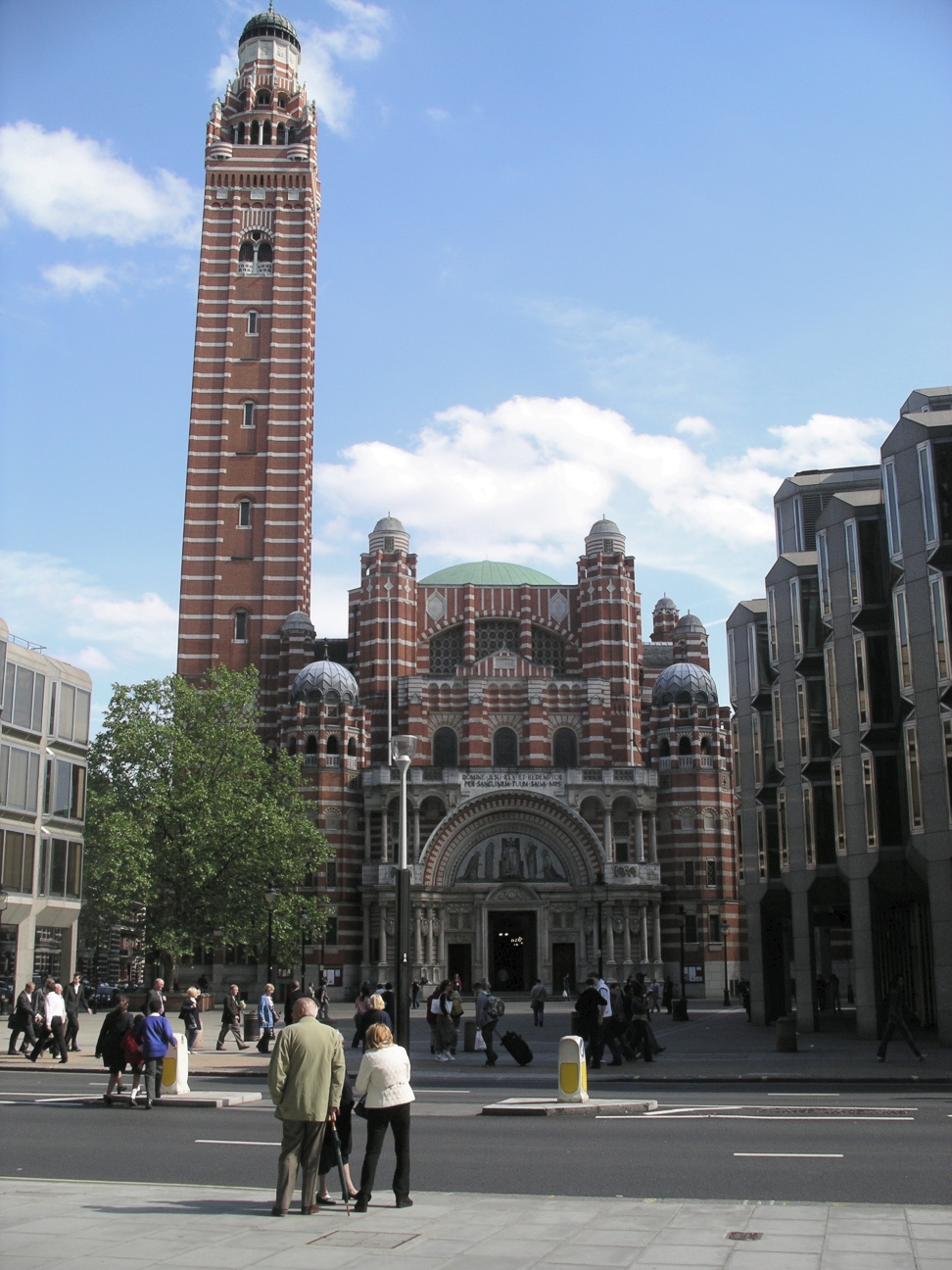
Two of these buildings were Westminster Cathedral along with Sir John Soane's House. Westminster Cathedral is the mother church of the Catholic community in England and has to be one of my favorite churches I've seen in Europe. Built a little over 100 years ago, the church looks very Byzantine both inside and out and has striped stone coursing much like the Duomo I saw in Siena only a few days earlier. I spent a good amount of time looking around the church and also got the opportunity to go to the top of the bell tower and get a panoramic view of London, which was a real treat. Sir John Soane's House was the residence of one of England's most famous architects, Sir John Soane, who was responsible to designing many buildings, churches, and homes throughout England, most notably the Bank of England. He also designed his own house and filled it with all sort of casts and statues. Basically, the house was a gigantic storage facility for architectural precedent. Exploring the house was an interesting experience. The walls were full of casts and moldings and no two rooms were the same.
The real highlight of the trip came on Saturday when I decided to take a day trip to Bath, a two hour train ride outside of London. I hopped on a train early in the morning at Paddington Station and hurried off towards the city famous for its classical architecture and having the only natural hot springs in all of England. Bath was originally settled during Roman times and has just as much Roman ruins and artifacts as many cities I've visited in Italy. The main highlight of the city is the reconstructed Bath Complex and the adjoining museum, but I spent coutless hours walking around to see many of the other incredible urban developments built in the 18th century.
Bath was an incredibly beautiful city, with its white stone buildings occupying the valley and hills along the River Avon. That day, Bath was even more beautiful because everything was covered with a thin layer of snow that continued to build as more snow fell throughout the day. I walked the streets seeing many of the famous structures like Bath Abbey, the Circus, the Royal Crescent, and many more. It was amazing to walk through such a small city (80,000 residents) and see beautiful architecture on literally every corner. Imagine of South Bend was like that...
I thoroughly enjoyed my time in England, and I wish I had more than just four days to explore it. I could have easily spent another week in London and still not seen everything that I'd want to. There are also so many other cities, Liverpool, Oxford, and Cambridge just to name a few, along with tons of cathedrals in other places that I would have loved to visit. There is only so much you can do in one trip. Hopefully, I will find my way back to England in the future to further explore its cities and countryside.
Rainy Tuscany, Sunny Florence
It rained even when it was sunny. Seriously.
After spending the first part of the day in Montepulciano we took a quick stop in the small town of Pienza. We went to look at a couple interesting urban interventions along the main road of the town that hugs the hill which the town is constructed on. These included a very interesting piazza in front of the main church and a rather interesting set of rowhouses; however, Pienza will forever be remembered in my mind for one of the most gorgeous views of a landscape I've ever seen. As we walked back down the main street towards the main church, the sun brilliantly broke out of the clouds and cast beautiful rays of sunshine over Pienza and the surrounding countryside. The pictures can barely do the experience justice.
We then spent the next day and a half in the city of Siena, one of the most famous Tuscan cities, known worldwide for its annual horse race, the Palio, held in the main piazza in the center of town every summer. Siena continued the theme of beauty, epitomized by its Duomo and Palazzo Pubblico, a major building in the main piazza. The Duomo, the main church in Siena was a gorgeous and towing building, constructed of alternating black and white stone courses. We spent nearly 30 minutes looking at the interior and all the beautiful artwork and sculpture that accented the structure.
You might have noticed the picture of the Duomo is an aerial shot. I took that picture from the top of the bell tower of Palazzo Pubblico. For a fee one can climb to the top and get sweeping views of Siena and the surrounding area. It was a truly incredible experience, climbing hundreds of steps in narrow cramped passages up to the very top of the 330 foot tall masonry tower. The people in the main piazza below seriously looked like ants and you could see for miles in every direction. While I was up there I had the unfortunate experience of having the bell ring while I was directly below it, signaling it was 1 o'clock it in the afternoon. I literally jumped out of my skin. I'm glad that I didn't go up there an hour earlier, as having twelve chimes instead of one would have been a lot worse. In the end it was a very worthwhile and rewarding experience. I was one of only a few people in the class to actually climb the tower.
Right after climbing the tower and getting lunch in Siena, we got on the bus and shuttled off to the town of San Gimignano, most well known for its mutitude of tall, medieval towers. Back in the day there were over 120 of these towers in the relatively small town, but many of them either fell over or were torn down. Now, only towers 14 survive. It was very interesting driving towards the town and seeing the large gray towers looming before us through the rain. We took a stroll through the town, seeing many of the towers and a couple of churches before hurrying back to the bus as dusk began to set in.
An hour or so later we arrived in Florence, the final destination for a field trip. Sadly, we would only get to explore the city and all its architectural beauty for one day. Even with the short amount of time, and the multitude of things to see, I still thoroughly enjoyed the trip to Florence. One of the nicest things about our time in Florence was the absence of the rain that had plagued every leg of the field trip up to that point. In fact, it was sunny for almost the entire day. After spending most of the day walking around Florence seeing the various architectural sights and crossing over the River Arno via the famous Ponte Vecchio a couple of times I got the opportunity to climb yet another famous structure, the dome of the Cathedral of Santa Maria del Fiore.
The dome of Santa Maria del Fiore was and still is the largest masonry dome ever constructed. It spans a distance of 144 feet and rises 375 feet above the city, built entirely without the help of centering (there wasn't enough wood in Tuscany to build any). The dome itself is considered to be one of the most intuitive pieces of engineering ever and is one of Italy's most iconic buildings. Only one day after climbing the bell tower in Siena, I again paid a small fee to climb to the top of yet another extemely tall structure. After climbing up a spiral staircase through the drum that supports the dome, one has to walk around a balcony that overhangs the interior of the church, where people walk about nearly 200 feet below. From there, you enter back into the physical stucture and wind your way up the interior of the dome to the very top. Once emerging from inside, I was greeted by incredible views of Florence in every direction. Yet again, it was one of those once in a lifetime moments. It's not every day that you can climb to the top of a building you've been learning about since your freshman year of college.
After climbing to the top of the dome and exploring Florence a little bit more, it was time to head back to Rome. Although we had only been away for three days, the entire class was exhausted and tired. The rain took a lot out of us, and everyone was ready to get back and sleep in our own beds back in Rome. Overall, Tuscany was a great time. I got to see some incredible architecture and eat some good food along the way, too. Not even constant rain can outweigh that.
We left Florence around 6 o'clock that evening. My flight to London for Thanksgiving Break was leaving in a little over 12 hours. It was going to be a quick turn around.
Tuesday, December 7, 2010
It's Been a While...
No worries, though. Once I have my final project turned in and my final drawing assignments completed, I will type up a couple entries detailing my trips to Tuscany and London along with a reflection on my first semester in Rome.
Time to get back to work.
Sunday, November 14, 2010
Reflections on Two Months in Rome
It is very easy, as I have learned, to just sit around the architecture studio all day, catching up on news back home or watching TV shows on the internet (with a little bit of drafting and design work thrown in, of course) without once setting foot outside. I've been guilty of this a couple of times, but I always try to get out, do a bit of exploring, and see something new I haven't seen before. It's crazy to think that even after being here for a couple months there are dozens and dozens of streets not even five minutes away that I have never walked down. There are still hundreds of churches I haven't peaked inside. When I have some free time in my schedule I might decide to take a different route home, and sometimes I get lucky and stumble upon one of the many hidden gems that exist down the backstreets of Rome.
Saturday, November 6, 2010
Island Hopping on Santorini and Ios
I awoke around 7:15am after a long, uncomfortable night of sleeping on a ferry and upon looking out the window was greeted by the towering cliffs of Santorini, the first of the islands we would be exploring. After docking at the port, we were picked up and taken to our hostel on the far side of the island. After getting settled at the hostel, we rented some ATVs from the bike shop right next door and spent the rest of the day exploring the island.
Santorini is a volcanic island like many of the islands in the Aegean, but what makes Santorini unique is that the island the volcano formed rings and ancient caldera that collapsed into the sea a long, long time ago. So, basically the entire western side of the island is perched on high cliffs overlooking the ancient sea-filled caldera while the eastern side slopes down towards long expanses of blank and red volcanic sand beaches. The island is most known for the whitewashed beauty of its two largest towns along the western edge of the island, Fira and Oia, and the beautiful sunsets one can see across the caldera.
Having ATVs was extremely convenient as it allowed us to explore the entire island in a relatively short amount of time. We went from end to end, spending time in the northern most town of Oia and the main town of Fira in the middle, while still having time to catch a sunset at the lighthouse on the southern tip of the island. The combination of scenery and architecture along the way was incredible. Oia and Fira are built into the sides of the cliffs and homes are literally stacked on top of one another. As you walk through the narrow streets you emerge on the edge of the cliffs and are presented with a sweeping view of the rest of the island and the sea hundreds of feet below.
The next day we took an excursion on a boat across the caldera to the active volcano on a smaller nearby island and the adjoining natural hot springs. The boat rode up and down heavy swells whipped up by swirling winds and splashed huge amounts of spray in our general direction. Upon arriving at the volcano, we hiked up to the summit a thousand feet above the water, passing steam and sulfur vents along the way. The summit provided excellent views of the inhabited main island across the way. I also had the satisfaction that I was on top of a volcano, something that not too many people can say they've done. After the hike up the volcano we got back on the boat and went around the island to where the hot springs were located.
The trip to the hot springs was one of the more interesting things I've done so far since leaving the United States. They are located in a shallow cove behind the volcano and can only be accessed by jumping into the ocean from a boat 150 feet off shore and swimming the rest of the way in. So, we stripped down to our swimsuits and dove off the edge of the boat into the fairly cool water. The swim to the springs wasn't too bad, but was more difficult than it normally would have been due to the large waves. As we got into the cove, the water warmed up significantly and was also a lovely red hue (due to the high iron content of the volcanic rocks). We floated around for a while before having to swim back out to the boat and head back to the port. We were shivering as we finally got back on the boat but in the end the experience of the hot springs was well worth it.
Later in the afternoon we took another ferry to the nearby island of Ios where we would be staying until heading back to Athens to catch a plane back to Rome. Our time on Ios was a rather interesting experience mainly because had arrived after the main tourist season. Ios is an island of only 1000 people and once the tourists leave everything shuts down. There were probably only a few dozen non-residents on the island while we were there. In fact we were the last people staying at our hostel before it closed for the season. So, a vast majority of the restaurants, bars, and bakeries were closed.
Regardless of the emptiness and lack of places to eat, Ios was still a beautiful island. Our hostel was perched halfway up the side of a large hill and had an incredible view of the main town and the ocean beyond. Like Santorini, Ios had beautiful white washed buildings and plenty of blue domed churches strewn throughout.
In the short time we were on Ios, we explored the main town and tried to find any food available (there were only two restaurants open that we saw), and afterwards took a walk to the most gorgeous beach on the island a mile or so down the road. Unlike Santorini, the beach on Ios had beautiful white sand, free of rocks of any sort. I was told that during the summer the beach has upwards of 5000 people on it everyday. On that day, we were the only people on the beach even with crystal clear blue skies and temperatures in the 70s. Before we knew it, it was time to head back to the hostel, pack things up, and catch the ferry back to Athens.
The time spent on the islands in Greece was a relaxing and enjoyable way to cap off a week that saw us travel hundreds and hundreds of miles between three different countries by land, air, and sea. With the lack of tourist noise, we got to enjoy the scenery and simplicity of life of the islands. The weather could have been nicer, but who can complain with spending a couple of days on the islands in Greece? I certainly won't.
Tuesday, November 2, 2010
Athens: Architectural History All Over Again
We arrived in Athens from Istanbul around noon and quickly got on an express bus to take us downtown to our hostel, just a few blocks away from the Acropolis and the famous Parthenon. The bus ride took us though the massive urban area that is Athens, but never got us to our final destination. The bus took a turn a dozen or so blocks short of the last stop and the driver told everyone to get out. The reason being that the main street we were on was barricaded by two police buses and a line of police dressed in riot gear. Apparently, a large group of Greek workers on strike were having a rally down the street and the police were there to make sure it didn't get out of hand and protect various government buildings. It was a bit hectic and nerve raking walking down the street as the riot police lined up in front of their roadblock and as the strikers chants grew ever louder in the distance and luckily we decide to take a detour in another direction.
Nothing bad ended up happening that day, and as we moved past the commotion of the road block we eventually found our way to the hostel and then set out to explore what we could for the rest of the afternoon. We ended up checking out the Panathenaic Stadium, where the first modern Olympics were held and also the site of where the ancient Olympics were held. We took a quick tour of the stadium as the sun began to sink behind the hills, eventually climbing to the upper tier of the stadium. It was there were we got our first breathtaking view of the Acropolis perched high above the city in the fading light. It was our first real confirmation that we were in Athens, a city of great architectural and historical value.
We spent the next day exploring the major architectural sights on and around the Acropolis. Our first stop was the recently built Acropolis Museum where we spent a good deal of time exploring and discussing the various pieces of frieze, sculpture, and artifacts preserved within the museum. The most interesting area of the museum was the uppermost floor which had a good amount of the preserved sculpture of the pediment and the entablature of the Parthenon. It was also interesting to learn how various events over the years, such as an explosion of gunpowder stored within the structure destroyed much of it during the 17th century and the carrying awaying of many sculptures and other pieces by Lord Elgin of Britian, made the Parthenon look like it does today. They don't like Lord Elgin very much in Greece.
After spending a couple of hours in the museum it was time to go explore the Acropolis itself. Through wave after wave of tourists we trekked our way up the slopes to the shelf of the Acropolis where all the great temples stand. This was where the knowledge we've acquired through architectural history classes kicked in. After entering the main gate to the Acropolis, the Propylaea, flanked by the tiny Temple of Athena Nike, we were offered an excellent view of one of the world's most famous structures, the Parthenon.
The Parthenon is a beautiful structure and is a sight worth visiting for anyone, but as an architecture major one has a special appreciation of it not only for its beauty but also for the subtleties in the methods of design. Instead of talking about the beauty of the marble and the massive scale of the Parthenon we talked about the curvature of the stylobate, ratios of height to width, and the fluting of the columns. Being able to analyze a building in its architectural elements really helps one see beyond what a building simply looks like and begin to explore the underlying layers of construction and tectonics that make a building both stand up and look the way it does.
We discussed the Parthenon as we walked around the entire structure and then checked out some of the other buildings on the Acropolis including the famous Erechtheon and its Caryatid Porch. The Caryatid Porch was another thing we had learned so much about in history classes. The porch contains a group of 6 columns shaped like female forms that seem to be holding up the entablature above them. As I stood there before the structure I couldn't help but smile and think that only a year or two ago I was back on campus at Notre Dame learning about what lay before me. It's really interesting when things come full circle like that.
After visiting the Acropolis, we hiked down the hill and saw a few more buildings before heading back to our hostel to rest up before dinner. It started raining soon after this and didn't let up for the rest of the day and most of the night. Luckily, we got everything we wanted to see in before it rained.
Athens was a great city to visit and it was incredible to see many of the buildings we had learned about back on campus. Like other places I'm sure I could have spent many more days exploring other parts of Athens and the different thing it had to offer, but we had a night ferry to catch and do a little bit of island hopping.
In closing, I'll let you know my favorite thing about Athens....
Monday, November 1, 2010
Istanbul - City on the Bosphorus
After a rather uneventful flight we touched down at Sabiha Gökçen Internation Airport on the Asia side of Istanbul marking my first time is Asia. We had to quickly buy visitors visas at the airport but once we had that taken car of, we hurried outside to catch a coach bus that would take us from the airport to the city center on the European side. I ended up being in Asia for only about an hour.
The bus ride into Istanbul was my first exposure to a non-Western culture, specifically the world of Islam. As we passed rows and rows of apartment buildings, standing among them where dozens and dozens of minarets from the multiple mosques. They were everywhere, and they all looked quite beautiful, as their ornate and classical facades offset the bland, concrete apartment buildings that surrounded them. It was also interesting to see signs and advertisements written in Turkish. I didn't have much time to study up on Turkish before leaving Rome so it was like trying to interpret hieroglyphics. We drove over the Bosphorous, the strait that separates the Asian and Europeans halves of Istanbul, and took a winding route to our final stop for the bus in Taksim Square.
After a quick walk and tram ride, we arrived at Istanbul's in between the two most famous structures and mosques, the Hagia Sophia and the Blue Mosque. We arrived too late in the day to go inside either, but they were still amazing to behold from outside. There were domes wherever you looked and both were surrounded by towering minarets. Simply marvelous structures.
We used the 36 hours exploring Istanbul and the many different sights it had to offer. We spent a great deal of time at the Topkapi Palace, home to a vast majority of the sultan's that reigned over the Ottoman Empire. The architecture was amazing and all of the different buildings were full of artifacts, including an 87 karat diamond ring worn by one of the sultans.
We also went to the famous Grand Bazaar and the nearby Spice Bazaar. The Grand Bazaar was absolutely gigantic, and it was extremely easy to get lost in as we found out a couple of times. The bazaar had all sort of goods ranging from rugs, to jackets, to shoes, and everything in between. The interesting thing about the bazaar is that most places don't have prices on anything. Prices are determined by bartering. It was pretty interesting seeing people arguing over jackets and t-shirts. The Spice Bazaar is pretty self explanatory in the fact that the vendors there sell all sorts of spices and herbs, but one can also find teas, desserts, and all sort of other goods. I ended up getting a shirt and a flag at pretty decent prices at the bazaars.
The most interesting and beautiful place we visited was the Blue Mosque. I mentioned the beauty of the exterior earlier, but if the exterior can be described as beautiful then the interior can only be described as breathtaking. The interior of the mosque was extremely open and airy with its lofty domes and high clerestory windows that shed light throughout the inside of the building. Ornate tile arabesques covered every surface. There wasn't anything spectacular or overly unique about the design or layout of the mosque, but its simple beauty and geometric patterns leaves the viewer in awe. We spent a good half an hour just staring and marveling at the beauty and peace expressed by the mosque's impressive architecture and decoration.
I absolutely loved Istanbul. It was a gorgeous city, and I'd love to go back some time. It was great to experience another culture in a part of the world so different from where I'm from. So many new experiences and differences that I will appreciate for years to come.
Fall Field Trip to Venice and the Veneto
We started our trip with a long four hour train ride from Rome to Venice. Upon arrival in Venice, I was surprised to find that immediately upon exiting the train station you become emersed in the controlled confusion of the winding canals and busy waterways of the city. The famous Grand Canal is right outside the entrance of the train station, and before I knew it we walked down the water's edge to catch a water taxi that would take us towards our hotel.
A trip down the Grand Canal is an experience within itself. Boats, gondolas, and water taxis of every size and shape move up and down the canal transporting goods and people along its entire length. Beautiful medieval and Renaissance palaces and homes line the shores of the canal. For most of the buildings the front door leads directly up to the canal where you can hop into a waiting boat and go off to wherever the day's business required.
We explored the narrows streets, alleyways, and the numerous canals of the city for three days, taking in all of the beautiful architecture that has been erected in Venice over the years. A major focal point was Piazza San Marco, home the the famous Basilica of San Marco and the well-known Doge's Palace. I got the opportunity to visit both the basilica and the palace. Both structures were spectacular; however, I was surprised to find San Marco much smaller than I thought it would be. It was a large building but it was relatively small compared to many of the towering facades and naves one can find in many of the churches in Rome. Beyond Piazza San Marco, we explored many churches around the city, most either designed or inspired by the architect Andrea Palladio, who I'll talk about a little more later.
On another note, we were lucky enough to experience the aqua alta, or high water, while in Venice. It rained pretty hard one of the nights we were there and sure enough the rains flooded the low lying areas of the city. Since this happens on a fairly regular basis, especially during the rainy months in the fall and winter, the city sets up a series of raised walkways to allow people to walk the flooded piazzas and street. It was pretty interesting to see hundreds of people in the gigantic piazza confined to a series of walkways only a couple of meters wide. This was also the part of the trip where I was really glad I was wearing waterproof shoes.
We could have easily explored Venice for another week, but we still had a lot of architecture to see in the cities and towns in the countryside surrounding Venice. The first stop on our tour of the cities outside Venice was Vicenza, one of the most charming cities I've ever visited and also home to the previously mentioned Andrea Palladio.
Palladio is a very well known architect from the 16th century and is loved by anyone interested in classical architecture. So, basically everyone in the Notre Dame program, including myself, has a man-crush on him. Palladio got his start designing tons on beautiful buildings in Vicenza and then moved on to design many famous churches and other buildings in Venice. He did some incredible work in Vicenza and turned a town about the size of South Bend into one of the most architecturally beautiful cities in all of Italy.
Beyond his work within Vicenza proper, he is also famously known for the many villas he designed in the countryside surrounding the city. We spent one morning exploring some of these villas, including an extremely famous one, Villa Rotonda. Villa Rotonda holds a special place in the hearts of Notre Dame architecture students, not just for its beauty but also for simple fact we all spent the second half of the Spring Semester freshman year drafting and watercoloring plans, elevations, and perspectives of the building. So, getting the opportunity to see the villa up close and in person was a very special experience. We could have spent the whole day there and been happy but the villa is only open from 10am until noon on Wednesdays so we had a very limited time to visit before we were ushered out to continue with our journey.
The next few days found us exploring some other famous cities in the surrounding area, specifically Ferrara, Ravenna, and Bologna. One of the more interesting things discovered in Ferrara actually dealt with the cuisine. One of the more famous local dishes is pumpkin filled pasta with meat sauce. It doesn't sound all that appetizing, but it was some of most delicious food I've had in quite some time. Ravenna is known for its Byzantine architecture and mosaics. One of the most beautiful churches seen on our trip was in Ravenna, San Vitale, and it had some of the most beautiful artwork you will over see. Lastly, we spent some time in Bologna. The buildings here were on a much larger scale than elsewhere and all of the sidewalks were contained underneath loggias on the lower part of the buildings. One can walk freely on the sidewalks if it's and never get wet unless he or she must cross the street.
After Bologna, we were all pretty tired and were happy to get on the bus for a four our ride back to Rome. It was a great trip and we got the opportunity to see a lot of famous and beautiful architecture in a relatively short time. The weather wasn't too bad for the most part, the food was good, and the experiences were countless. A great week to say the least.
Saturday, October 23, 2010
Out and About
The reason for this is because I haven't had too much time to spend writing blog posts. I've spent the last few weeks cranking out an architecture project or traveling. It only continues from there. To top it all off, I'll be spending the next week traveling for Fall Break.
No worries, though. Once I get back I'll be sure to write a couple of posts on my experiences from my recent field trip to Northern Italy (Venice, Vincenza, Ferrara, Ravenna, and Bologna) along with my trip this coming week to Istanbul, Athens, and the Greek Isles.
So much to talk about already, but the coming week promises even more discovery and a taste of what lies beyond Italy's borders.
Monday, October 11, 2010
Under Saint Peter's Dome
We had secured tickets to the Mass earlier in the week and walked over towards the Vatican bright an early. As we drew closer, the dome and Bernini's massive colonnade surrounding St. Peter's Square grew larger and larger. You really don't get a scale of how large everything is until you are physically standing next to one of the columns and realize it is well over 6 feet in diameter. You are just dwarfed by the massive scale of every architectural element.
After going through security we were ushered up the front stairs and into the interior of St. Peter's Basilica. The scale of things outside was also reflected on everything in the interior. The pilasters, the ceiling coffers, the piers, the dome. Everything was just huge. Everything was simply incredible. I was glad we got there an hour before Mass started because not only did we get really good seats close to the central aisle, it also gave me a chance to simply look at all there was around me and just take it all in.
The Mass itself was another experience in itself. It is an extremely humbling experience to attend Mass in St. Peter's, the heart of the Catholic Church, along with thousands and thousands of others from all over the world. The procession of all the priests, bishops, and cardinals was phenomenal. Priests from all over the world walked past in different forms of traditional religious regalia. Those priests and bishops from the Eastern Rites were the most exceptional to see with their bejeweled robes in the traditional Byzantine style. Then came the Pope.
The Mass itself was equally impressive. A lot of the Mass was in Latin, but there were scatterings of English, French, Italian, Hebrew, Farsi, Syrian, and even Arabic at various parts of the liturgy. There were some beautiful chants in Arabic done during the Mass. It might seem odd to have Arabic, Syrian, and Hebrew in a Mass, but it was fitting in this case because the Mass was aimed at closing a week long series of meetings between the Pope and all the Bishops of the Church in the Middle East. So it was actually quite fitting.
The Mass ended, and the procession of all the priests and the Pope went out towards the back of the Basilica. The Pope walked by us again and to our surprise moved off his line towards the doors and headed towards our side of the church. He stopped about three rows behind us, blessed a little girl being held by her parents, and then countinued along on the procession towards the back of the church. The parents immediately began crying in happiness and everyone around them swarmed towards the child in joy. What a experience, and I'm sure it will be one of the greatest moments in the lives of that small family sitting a few rows behind us.
I will never forget my first trip to the Vatican. The architectural beauty of the Basilica and the Vatican along with the spiritual peace of the Mass and the faithful thousands will stick with me for years and years to come.
Sunday, October 3, 2010
Assisi: A Most Beautiful City
Saturday, September 25, 2010
Let's Get Down to Business
This work comes in a couple of different forms:

3. Food - If I was back at Notre Dame, I wouldn't have to even think twice about food. If I was hungry I just went to the dining hall and got lunch or dinner, and if I needed a late night snack I just walked over to LaFortune and picked up a couple of hot dogs. It isn't as easy in Rome. Nowadays, we either have to cook everything for ourselves, go to a restaurant, or starve. Also, not too many places near the studio are open late at night, so you have to take a decent walk in order to satisfy late night hunger. If only there was a Taco Bell somewhere.
4. School Work - Oh yeah, that's important, too. In the two weeks I've been here, I've put out 30 odd pages of sketches and notes in my various notebooks and sketch books, finished one project, and been assigned a second that is due in two weeks right before out field trip to northern Italy, all while being in class between 3 to 7 hours every day. In short, I've been fairly busy and it's only going to get more intense from here as we get deeper into the semester.
Let's get cracking.
Wednesday, September 22, 2010
Cinqueterre: First Weekend Away from Rome
Cinqueterre, for those of you who may not have heard of it, is a group of five villages nestled along the ocean on the northwestern Italian coast about 4 hours by train from Rome. They are all linked together by a group of four trails that go over all kinds of terrain and have the most spectacular views you will ever see. I had the oppertunity last weekend to take a trip to this amazingly beautiful part of Italy and saw some of the most incredible scenery I've ever seen in my life.
We arrived in the northern most of the five villages, Monterosso al Mare, a little after noon on Saturday after a long morning on the train. Even the view from the train station was spetacular. In front of us were the clear blue waters of the ocean flanked on either side by beautiful mountains that got lost in the low lying clouds all the way out to the horizon. We ended up eating lunch in Monterosso al Mare and then went down to the beach below the town.
The beach itself wasn't all that great because it was covered in rocks and dark, coarse sand, but the water was absolutely amazing. We spent around and hour swimming in the beautiful water where you could see the bottom no matter how deep it got. It's really difficult to describe the feeling of swimming amidst such beautiful scenery.
Unfortunately, when we got out of the water it started to rain a bit. So, instead of exploring more of Monterosso we decided to go back to the train station and head up to Levanto, were we would be spending the night in a hostel.
Levanto is just north of the five famous villages but is equally as beautiful. It is set in between two mountains at the edge of a hemispherical natural harbor. Later in the evening, I ended up going to a Vigil Mass at San Andrea, a beautiful Romanesque church a minute or two from the hostel. It was the first time I'd ever been to Mass in Italian. I paid attention to the homily, but I didn't understand a word of it. Other than that the Mass was a really great experience. We ended up getting dinner, strolling along the beach, getting some gelatto, and then went back to the hostel to get some sleep before a long day of hiking on Sunday.
Sunday itself was a blur. Beauty was everywhere we went and after a while you become almost desensitized by it. We started in Monterosso al Mare and took the first trail to the town of Vernazza. The trails on the first half of the journey were pretty challenging. The path took you to the tops of mountains, over tiny waterfalls, up and down flights of crude stone steps, and along narrow ledges. It was a real work out, but the views were definitely worth it. It literally feels like you are on top of the world as you see everything sprawled out before you.
Vernazza was an incredible little town right at sea level. We ended up eating lunch here and took a refreshing dip in the harbor after a long morning on the trail. The water was even clearer here that it was at Monterosso. The town is built into the side of a hill, so most of the streets were basically stairways. The main "street" that went down to the beach from the trail was a stairway maybe four feet wide. It is so interesting to think about how much the terrain can affect the look and layout of towns.
After lunch, we hiked to the next town of Corniglia, which was much more laid back than the previous two. It was perched high on a hill that juts out into the ocean and had sweaping views in every direction. As we walked into town, I noticed an old lady sitting on a bench talking to herself. At least that's what I though she we doing. In reality, she was actually talking to another old lady sitting on a third floor balcony in the apartment building across the street.
The last leg of the journey took a lot less time. The third path that led to the town of Manarola was closed because the rain from previous night increased the risk for mudslides. We ended up hopping on a train to get to Manarola and then hiked the last leg to Riomaggiore, the easiest part of the journey, just as the sun began to set.
In all, it was an incredible trip. The scenery was gorgeous, the towns and the buildings in them were fantastic, and the experience was unlike anything I've ever done before. It's incredible how much beauty there is in the world, and it was amazing to get the opportunity to see some of this beauty first hand.
Finally, before heading back to Rome, I had a very traditional Italian meal, a Big Mac and fries from the McDonalds at the train station. Very Italian, indeed.
Tuesday, September 14, 2010
Rome: La Citta Eterna
As I've walked the piazzas, gotten lost in side alleys trying to find the hotel, eaten pizza at restaurants in the shadow of famous buildings, I've learned that wherever you go there is history in every step. Rome is a city that has been built up over the centuries. The basements of today's buildings were yesterdays store fronts. Rubble and refuse from ancient structures and everything else that has piled up over the years has raised the city up dozens of feet in some places. I have learned so many interesting things about the city within the short time I've been here and I'm sure that I'll keep learning new things about this place until the day I leave.

Sketching in Piazza della Maddalena. An Italian guy walked
by a few minutes later and started oinking at me. Odd.
1. Pizza that is basically a sandwich with meat and cheese in between
2. Pizza that is like American pizza other than the fact it's really plain and is cold because it has been sitting at the counter for 3 hours
3. Pizza that is freshly cooked at a restaurant (aka Pizza Margaretta, etc.)
Types 1 and 3 are really good. I have tried to stay away from the second type. It lacks pizazz (no pun intended) and could use about a pound of pepperoni and sausage and get the assistance of a new invention that just came out a few years ago. The oven.
Nightlife has been great, too. After classes, my friends and I have gone out and explored the city and all it has to offer. There was one night where we sat on the Spanish Steps and just chatted. Another night, we ventured off to find a pizza place that we soon found out didn't exist and did the next best thing by eating at the restaurant across the street from its supposed location. We've seen quite a bit so far, but it still amazes me how much there is still to see. Luckily I have eight more months to see all the sights.
Saturday, September 11, 2010
Flights and First Perspectives
The domestic flights were pretty enjoyable and short, but the flight to Rome was not as comfortable. Where the flights from South Bend to Chicago and from Chicago to Washington, D.C. went by in a flash, the final flight dragged on and on. I could just never get comfortable. Economy class seats just aren't made to be comfortable for 6'7" people. Even though I tried to fall asleep, I ended up sleeping for only about 20 minutes of the eight hour flight. I ended up watching The Karate Kid twice and bits and pieces of Robin Hood in French. Yeah, I was that uncomfortable.
Any negative feelings disappeared when we reached Rome. I gladly got off the plane, got through passport control in the terminal, got my luggage, and within a few minutes took my first steps into Italy. I took my first breath of the fresh Italian air, and to my dismay instead got a lovely whiff of cigarette smoke. Not as romantic of a first impression as I had imagined, but I was enthralled to finally be in Italy none the less.
Ceiling, Il Gesu
With that in mind, I have spent the last hour or so studying maps.
Tuesday, August 31, 2010
Leaving Home
In my opinion, it doesn't matter how little (according to some people) this place has to offer. South Bend has been my home from birth and I am going to miss it quite a bit when I leave for Europe here in a little over a week.
I've spent basically my entire life within the confines of northern Indiana. There hasn't been much need to leave. Even now when a good number of friends have moved on to colleges and universities far from home I'm still right down the road. So, even though I've been away at college for the last two years, home has never really felt far away at all.
With my departure quickly approaching, everything is beginning to set it real fast. I realized the other day that once the plane takes off from South Bend Regional Airport next Thursday I won't being seeing home again until April of next year. So, I'm trying to enjoy my time here while it still lasts.
I'm for sure going to miss my family and my friends at Notre Dame. It's going to be hard to leave Martin's donuts and other local treasures behind (Carl Silliman knows what I'm talking about). I still can't fathom not experiencing football games and the atmosphere on campus during the Fall. It is going to be difficult to leave all that I know and love behind, but I look to the future with great anticipation. So many places to see, so many interesting experiences, so much good food.
Now if only my suitcase would pack itself...
Monday, July 5, 2010
Introduction: Roads Never Taken
At some point in our lives we have all become familiar with the famous last lines of Robert Frost's famous poem "The Road Not Taken." They read:
Two roads diverged in a wood, and I--
I took the one less traveled by,
And that has made all the difference.
We all have moments in our lives were we meet forks in the road and have to decide which route we want to follow. Other times, outlying circumstances beyond our control force us down one path or the other. I find my life to be no different. The choices I’ve made and the paths I’ve decided to follow have led me to where I am today. Sure, there have been detours along the way, but I wouldn’t have had things happen any differently.
However, now I find myself at a crossroads that I have never been at before. International travel. As I sit writing this, I am a little over two months removed from leaving for an eight-month journey to Italy. It will be the first time I’ve ever left the United States. There have only a couple of occasions where I’ve even left the Midwest. Some people at Notre Dame live thousands of miles away from campus. I live 9.37 miles from Notre Dame. Yes, I actually checked.
For me, it’s like a couple roads diverging and then branching off in more paths than I can count. There are so many new places to visit and many new experiences ahead of me. By the end of my journey I’ll probably have visited more European countries than U.S. states.
My goal with this year abroad is to discover the beauty of the places I go and apply what I learn to both my architectural studies and my life. I have been blessed with a great opportunity, and I plan on using it to its fullest. This journey will not be about finding the best roads to take. For me, it will be defined by finding the significance along whatever roads I take, no matter where they lead. That is what will make all the difference.
Lastly, I pray that more people other than my mom read this blog.


